Art and Design
Our Art curriculum for KS1-KS2 follows four main themes of painting, drawing, sculpture and textiles work, and will also produce work on digital photography.

ABOUT THIS CURRICULUM
Welcome to Eden Park's Art Curriculum
Our Art and Design curriculum was carefully reviewed by school leaders in April 2026. This review enabled us to make astute, subject-specific decisions to ensure that our curriculum provides rigour, breadth and full coverage of the National Curriculum.
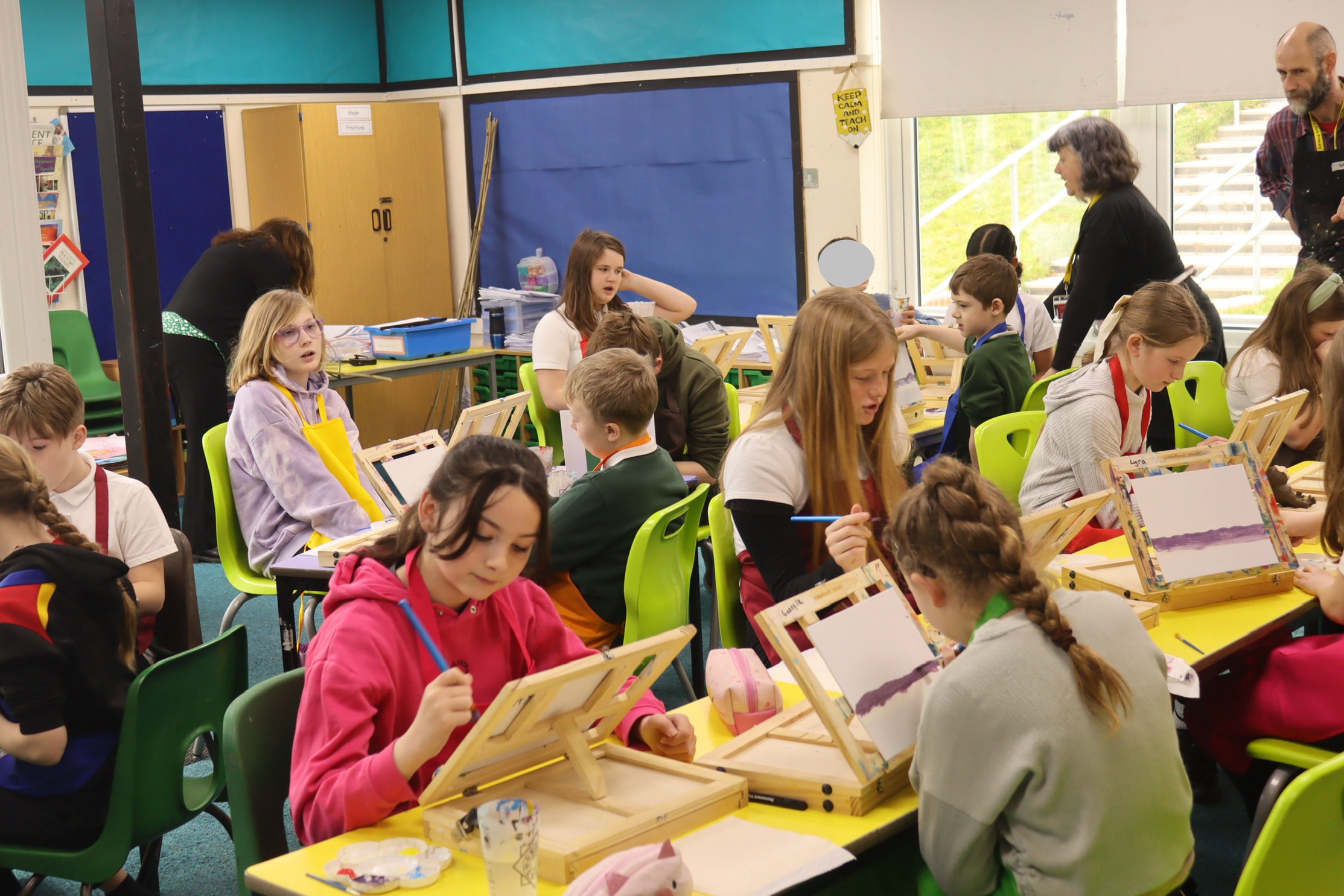
Art and Design is taught in our dedicated Art Studio – a space created to immerse, enrich and celebrate creativity. We want our children to develop a genuine love of art, whilst building the knowledge, skills and confidence to express themselves creatively.
Our curriculum is designed to ensure that children experience a wide range of artists, techniques, materials and creative processes as they progress through the school. We place a strong emphasis on developing both artistic knowledge and practical skills, enabling children to become increasingly independent, reflective and confident artists.
On this page you will find:
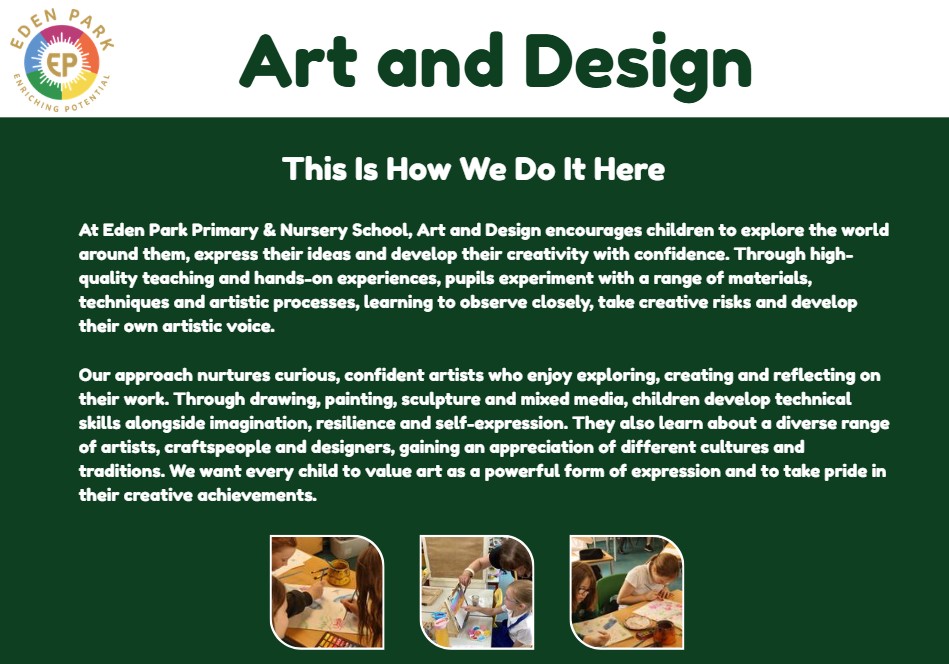
This Is How We Do It Here – Art
A summary of our intentions, expectations and approach to teaching Art and Design at Eden Park.
EYFS Art and Design Curriculum - An overview of the knowledge, skills and experiences children develop during their time in the Early Years Foundation Stage.
Art in Early Years is a rich and creative curriculum which focuses on developing children's artistic and imaginative skills. It emphasises exploring different joining methods such as glue, tape, paper clips, and split pins, and encourages malleable play with materials like flour and salt. Children are supported in experimenting with paint using fingers, brushes, and tools, as well as mixing colours and using techniques like salad spinners. Drawing skills are nurtured through a range of media and activities, including self-portraits and observational drawings. Creativity is further fostered through music, dance and role play, where children express emotions, develop storylines and work collaboratively. Independence is encouraged through skills like scissor use and tape dispensing. The curriculum also introduces children to various art forms such as abstract and 3D art, using specific vocabulary like “create,” “imagine,” and “join
Year 1 and 2 Art and Design Curriculum - Our curriculum journey for Key Stage 1, building foundational knowledge and developing children's artistic skills.
In Year 1, children will explore the work of famous artists, discussing the artists' intentions and examining their techniques. Drawing inspiration from these artists, children create their own paintings which are be displayed in an art gallery.
In Year 2, children will be inspired by the work of famous artists, creating abstract clay figures inspired by Henry Moore, wire figures inspired by Antony Gormley, and soap sculptures with curved forms inspired by Barbara Hepworth. Painting activities will include creating flower-like forms using coloured filter paper inspired by Dale Chihuly’s vibrant work.
Year 3 and 4 Art and Design Curriculum - Our lower Key Stage 2 curriculum, where children develop greater technical skill, knowledge and understanding.
In Year 3 and 4, children will explore various art techniques such as photography, digital manipulation, portraiture with pencil, charcoal, and white chalk, and experiment with different papers like brown paper and newspaper. They will focus on observation, proportion, and shading while examining how different artists, including Tony Piedra, Derek Gores, and others, have represented themselves and used materials like textiles and collage. The children will explore painting techniques, including colour mixing with acrylics and painting on various surfaces. Students will compare different artists’ styles, from Michelangelo to Edvard Munch, and discuss the purpose behind their work.
Year 5 and 6 Art and Design Curriculum - Our upper Key Stage 2 curriculum, where children refine their skills, make increasingly independent artistic choices and develop their own creative voice.
In Year 5 and 6, children will engage in observational flower drawing inspired by Charles Darwin’s exploration of life, using light pencil sketching and learning techniques like washes and layering to create textures in the sky. They will explore painting techniques for trees and plants while examining Darwin's paintings and connecting their work to history. Through projects like creating jellyfish from waste materials in the style of Eva Hesse, they will consider the message in their art and learn about the environmental impact of plastics on our beaches. They will also learn architectural perspective and 3D drawing techniques, drawing inspiration from architects like Frank Lloyd Wright.
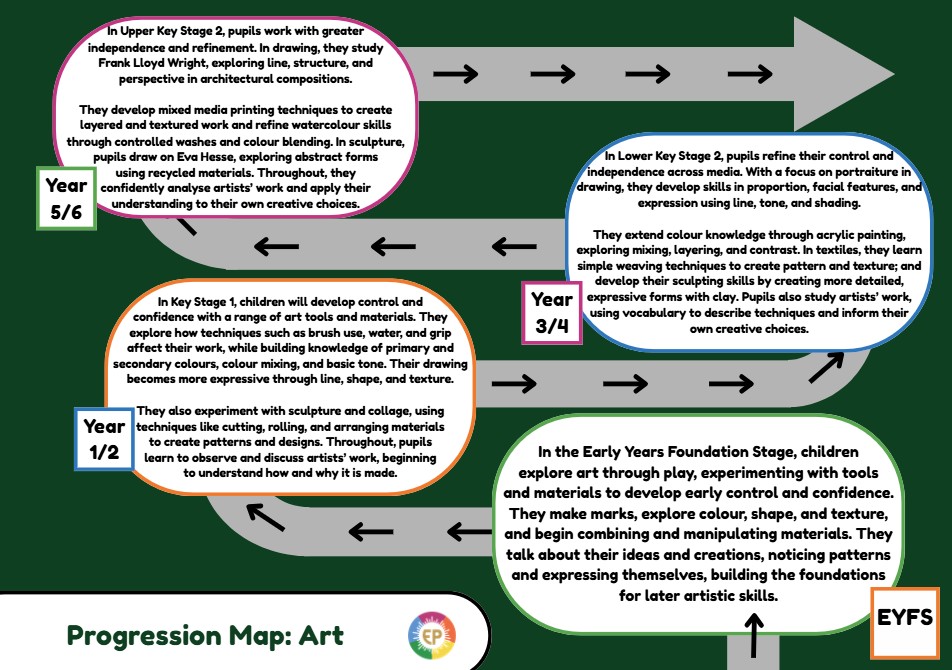
Art Progression Roadmap
A clear overview of the journey our learners take from EYFS through to Year 6, showing how knowledge, skills and techniques develop and build progressively over time.
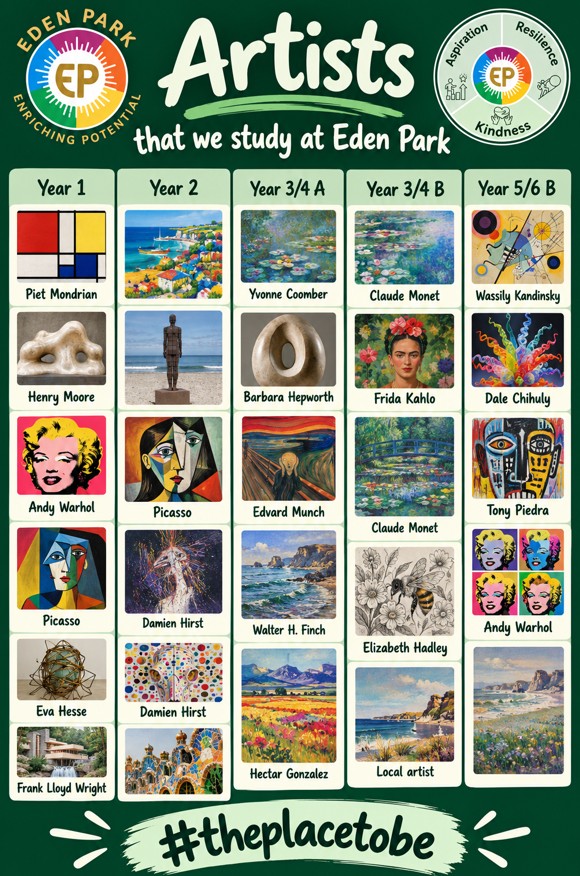
Our Artists
A summary of the artists our children will encounter throughout their time at Eden Park, highlighting the breadth and diversity of artistic influences within our curriculum.
Supporting Documents and Resources
Additional information and resources to provide further insight into our Art and Design curriculum, alongside ideas and materials that families can use to support and inspire art learning at home.
At Eden Park, we want every child to have the opportunity to create, explore, experiment and celebrate their creativity. Through our Art curriculum, children develop not only as artists, but as creative, resilient and confident individuals.
Guiding Principle of Aspiration in Art
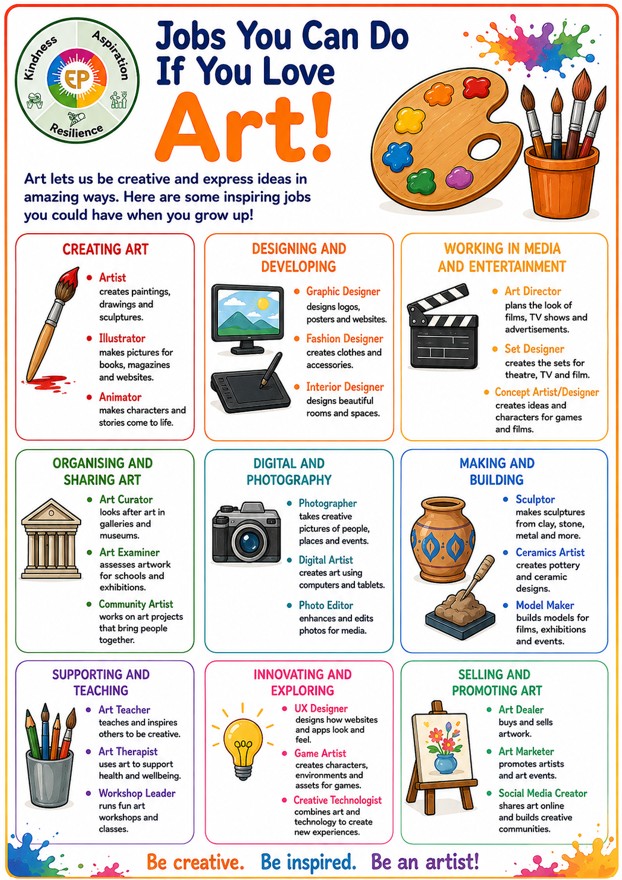
One of our Guiding Principles is Aspiration. We encourage our children to aspire every day, in everything they do, and to believe that their learning can open doors to a world of possibilities.
Whenever we begin a new Learning Enquiry in Key Stage 2, we share with the children examples of the careers and opportunities that their learning could lead to in the future. Whether they are exploring science, history, geography, art, computing or another area of the curriculum, we want them to see the real-world relevance of what they are learning.
By making these connections, we aim to open children's eyes to the wealth of possibilities available to them and help them understand that their learning today can shape their opportunities tomorrow.
We want every child to develop a “What could I become?” mindset — to dream big, recognise their own potential and understand that there are many different pathways to success. Most importantly, we want our children to leave us believing that their aspirations are within reach and that the knowledge, skills and attitudes they develop at school can help them to achieve them.
Enriching Art
At Eden Park, we enrich our art curriculum by immersing children in real-world artistic experiences. Children enjoy our visit to Brixham to observe and sketch architectural features like the historic Brixham Quay. Other trips to Brixham inspire children to create their own artworks, such as jellyfish sculptures crafted from recycled materials, echoing the environmental themes explored in our learning enquiries. Additionally, we collaborate with local galleries and artists, including A Kick Up the Arts in Brixham, to engage children in community art projects and exhibitions. Through these initiatives, children develop a deeper understanding of art's role in society and the environment, fostering creativity and cultural appreciation.