Design Technology
At Eden Park, Design and Technology isn’t just a subject—it’s a chance for your child to imagine, create, and thrive.

ABOUT THIS CURRICULUM
Welcome to Eden Park's Design Technology Curriculum
Our Design Technology curriculum has been carefully developed to ensure that children experience a broad, ambitious and progressive programme of learning. Our curriculum provides rigour, breadth and full coverage of the National Curriculum, whilst giving children meaningful opportunities to design, make, evaluate and improve their own products.
Design Technology is taught through practical, purposeful and creative experiences, enabling children to become innovative designers, skilled makers and thoughtful problem-solvers. We want our children to understand how the products and structures around them are designed and made, whilst developing the confidence and technical knowledge to create solutions of their own.
Our curriculum is designed to ensure that children encounter a wide range of materials, tools, mechanisms, structures, electrical systems, textiles, food and digital technologies as they progress through the school. We place a strong emphasis on developing both design knowledge and practical skills, enabling children to work increasingly independently, make informed choices and refine their ideas through an iterative design process.
On this page you will find:
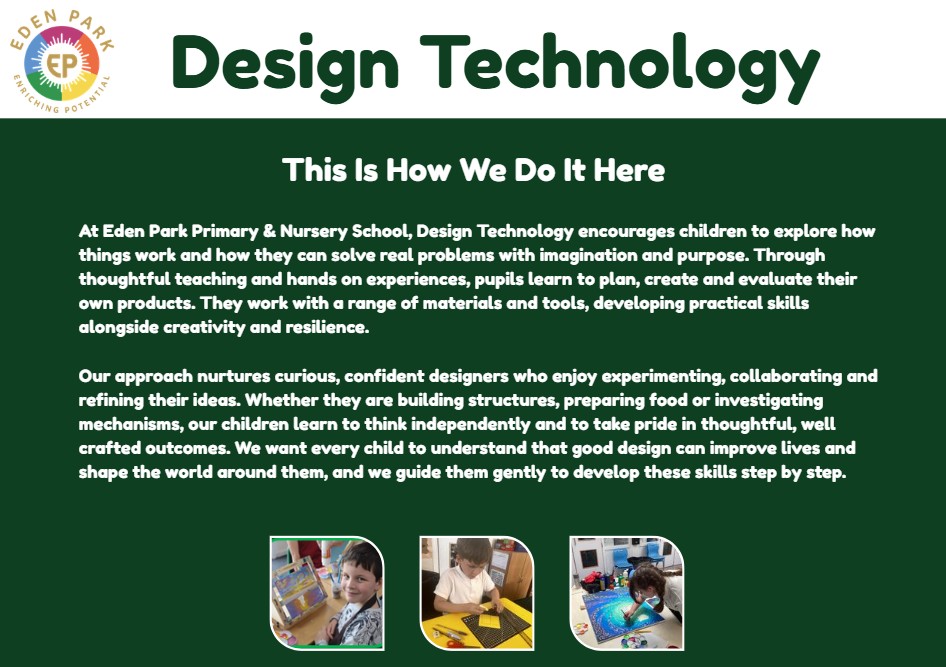
This Is How We Do It Here – Design Technology
A summary of our intentions, expectations and approach to teaching Design Technology at Eden Park.
EYFS Design Technology Curriculum - An overview of the knowledge, skills and experiences children develop during their time in the Early Years Foundation Stage.
In Early Years, children would encounter Design Technology through ‘Expressive Art and Design’. Here children would have had plenty of opportunities to explore different materials and mediums through their continuous provision activities. Joining and assembling: They will use cold glue guns and tape to join and assemble materials with a purpose in mind when joining materials. Children can fold paper and card to create the desired effect e.g. paper plane.
Construction: Children create complex structures becoming more imaginative in their block play and begin to create elaborate and complex designs, using their understanding of pattern, shape and balance. Children will start to use blocks to represent things that they know, that in turn enhance their play, for example a car or an animal, house or train station. Daily snack time provides a perfect opportunity to consider healthy food choices and further opportunities to learn about food and nutrition are offered throughout the year. Continuous provision provides plenty of opportunities to practise and explore joining, making, using tools and creating using different materials and evaluation is always encouraged. These foundations are built upon as children journey through Year 1 and KS1.
Year 1 and 2 Design Technology Curriculum - Our curriculum journey for Key Stage 1, building foundational knowledge and developing children's designing and making skills.
In Key Stage 1, children begin to explore the world of Design and Technology through engaging and practical enquiries that focus on mechanisms, food and nutrition, and textiles. Pupils learn to use simple tools and joining techniques to create purposeful products, such as moving mini-beasts, puppets and picnic snacks. Throughout these projects, they follow the process of designing, making and evaluating, developing their confidence and creativity. They are introduced to basic food hygiene, begin to explore healthy eating, and practise basic stitching techniques. The curriculum encourages exploration and imaginative thinking, setting a strong foundation for more complex learning in Key Stage 2.
Year 3 and 4 Design Technology Curriculum - Our lower Key Stage 2 curriculum, where children develop greater technical skill, knowledge and understanding.
In Lower Key Stage 2, pupils build on the foundational skills from KS1 by deepening their understanding of design processes and practical application. Through themed projects such as moving monsters using pneumatics, seasonal food dishes and designing functional pencil cases, children apply their knowledge in a wider range of contexts. They are introduced to new tools and techniques, such as the use of annotated sketches, accurate measurements, and more precise stitching methods like back stitch and whip stitch. Pupils begin to make links between their D&T learning and other subjects, including science (pneumatics), geography (seasonality of food), and computing (design presentations), while developing resilience and problem-solving skills.
Year 5 and 6 Design Technology Curriculum - Our upper Key Stage 2 curriculum, where children refine their technical skills, make increasingly independent design choices and develop their own solutions to real-world problems.
Upper Key Stage 2 challenges pupils to apply their design and technology skills with increasing independence and sophistication. They tackle complex projects such as creating moving toys with cams, designing fairground rides using motors and circuits, and crafting wearable slippers that combine both function and aesthetic appeal. Pupils plan using cross-sectional diagrams and CAD software, evaluate their work critically, and consider user needs and sustainability. Cooking projects such as bread making and gourmet burgers allow them to explore food preparation, nutrition and cultural influences. Throughout, children are encouraged to take creative risks, reflect on feedback, and develop products that solve real-life problems.
Design Technology Progression Roadmap
A clear overview of the journey our learners take from EYFS through to Year 6, showing how develop and build progressively over time.
Supporting Documents and Resources
Additional information and resources to provide further insight into our Design Technology curriculum, alongside ideas, activities and materials that families can use to support and inspire Design Technology learning at home.
At Eden Park, we want every child to have the opportunity to design, make, test, evaluate and improve. Through our Design Technology curriculum, children develop not only as designers and makers, but as creative, resilient, resourceful and confident problem-solvers who are equipped to look at the world around them and imagine how it could be improved.
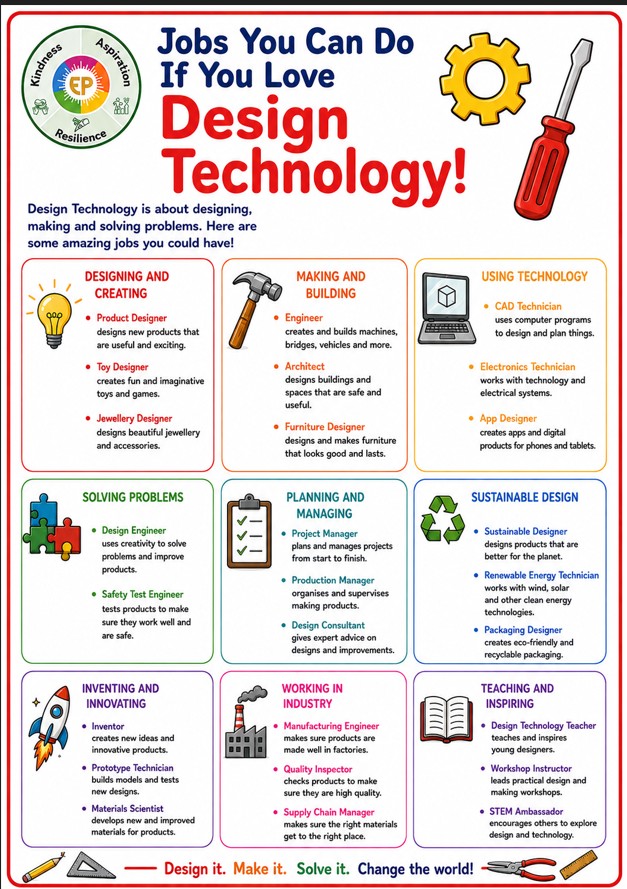
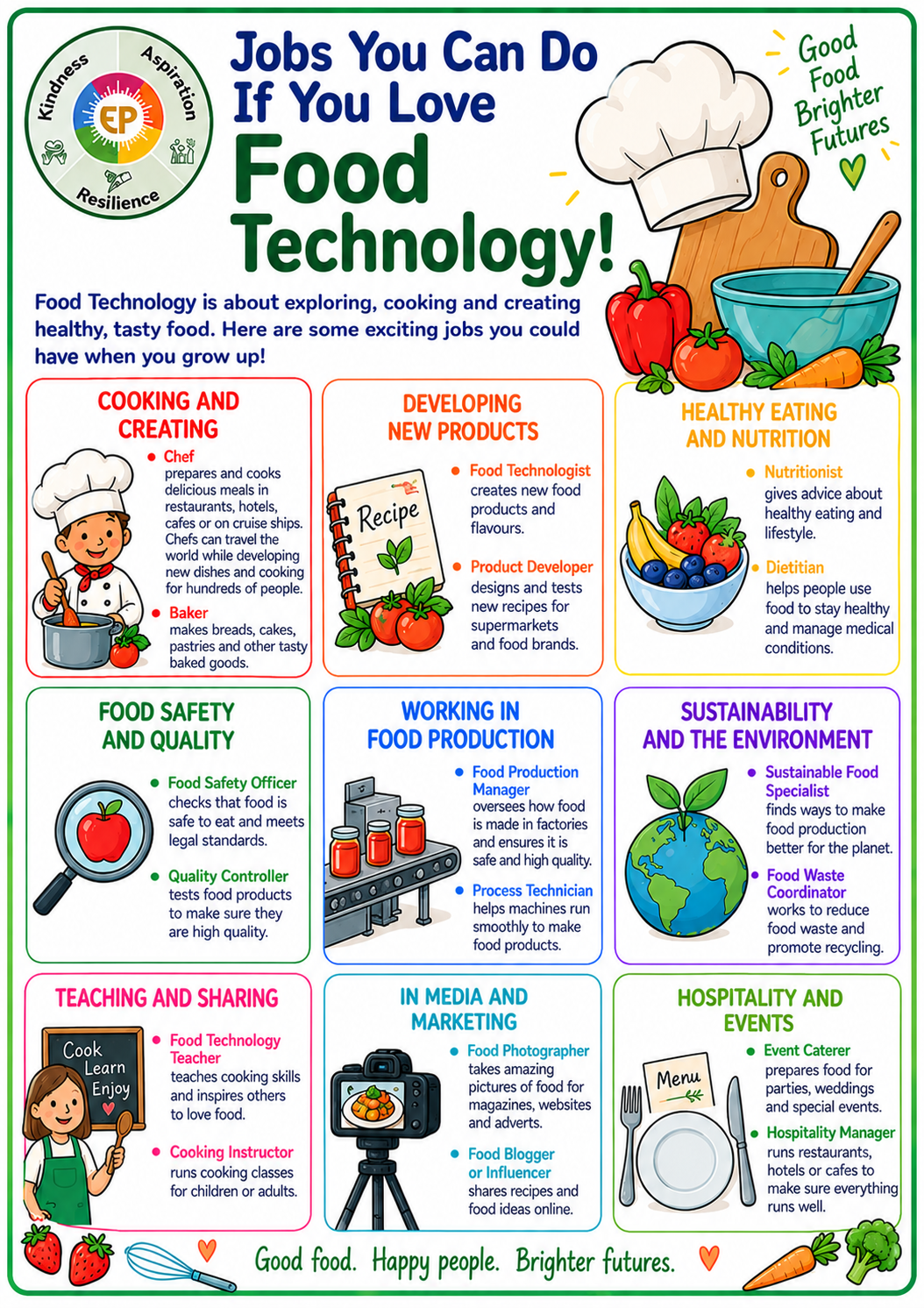
Guiding Principle of Aspiration for Design Technology
One of our Guiding Principles is Aspiration. We encourage our children to aspire every day, in everything they do, and to believe that their learning can open doors to a world of possibilities.
Whenever we begin a new Learning Enquiry in Key Stage 2, we share with the children examples of the careers and opportunities that their learning could lead to in the future. Whether they are exploring science, history, geography, art, computing or another area of the curriculum, we want them to see the real-world relevance of what they are learning.
By making these connections, we aim to open children's eyes to the wealth of possibilities available to them and help them understand that their learning today can shape their opportunities tomorrow.
We want every child to develop a “What could I become?” mindset — to dream big, recognise their own potential and understand that there are many different pathways to success. Most importantly, we want our children to leave us believing that their aspirations are within reach and that the knowledge, skills and attitudes they develop at school can help them to achieve them.
Enriching Design Technology
Design and Technology at Eden Park is enriched through strong local links and real-world learning experiences. Trips to places such as Brixham fish market and 5 Doors Up bakery bring the curriculum to life, giving children firsthand insight into how products are designed, made and used in everyday life. Pupils are encouraged to grow their own ingredients, collaborate on design challenges, and showcase their outcomes to families and the wider community. For those with a passion for the subject, the Graduation scheme offers a pathway to further explore influential designers and engineers, nurturing aspirations and broadening horizons. The curriculum also champions sustainability, ensuring children develop a strong sense of environmental responsibility in their design choices. Please see 'Enriching the Curriculum Yr-Y6' for further information.


