Computing
Our Computing curriculum for KS1-KS2 follows three main themes which enable our children to become confident digital citizens.

ABOUT THIS CURRICULUM
Welcome to Eden Park’s Computing Curriculum
Our Computing curriculum was carefully reviewed by school leaders in April 2026. This review enabled us to make astute, subject-specific decisions to ensure that our curriculum provides rigour, breadth and full coverage of the National Curriculum.
Computing is an essential part of life at Eden Park. Our curriculum is designed to equip children with the knowledge, skills and confidence they need to understand the digital world, use technology effectively and become safe, responsible and creative digital citizens.
We want our children to see Computing not simply as using computers, but as a subject that develops problem-solving, logical thinking, creativity and resilience. Through a carefully sequenced curriculum, children learn how computers and digital systems work, how to create and manipulate digital content, and how to use technology safely and responsibly.
Our curriculum is designed to ensure that children experience a broad range of computer science, information technology and digital literacy as they progress through the school. Knowledge and skills are revisited and built upon, enabling children to become increasingly independent, confident and capable users and creators of technology.
On this page you will find:
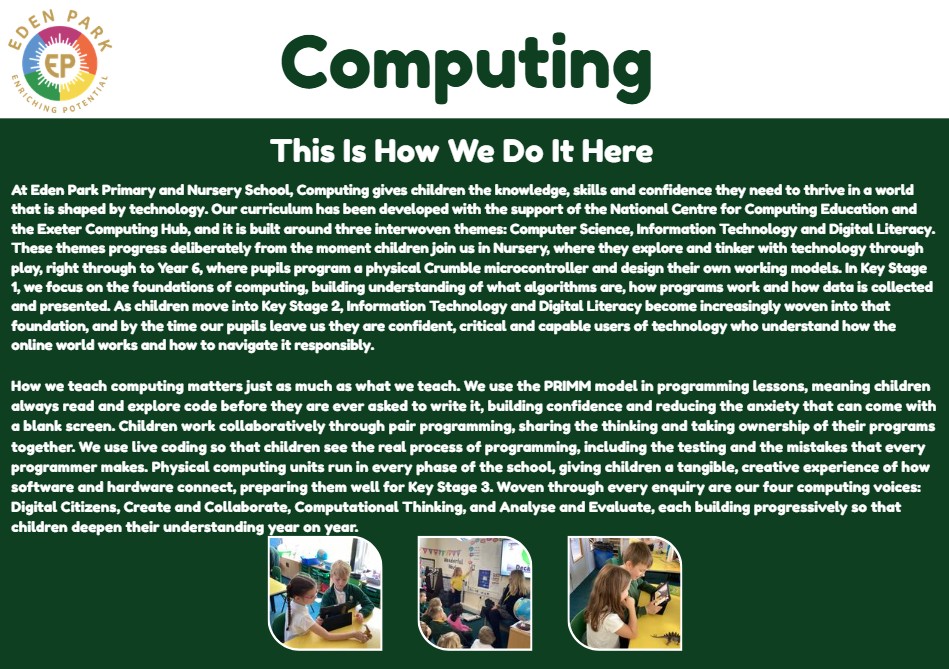
This Is How We Do It Here – Computing
A summary of our intentions, expectations and approach to teaching Computing at Eden Park.
EYFS Computing Curriculum - An overview of the knowledge, skills and experiences children develop during their time in the Early Years Foundation Stage.
In the EYFS, our curriculum is designed to engage children through play-based learning and hands-on challenges aligned with the EYFS framework. Role-play areas feature a range of technology, including iPads, desktops, and electronic toys like remote-controlled cars and interactive pets. By tinkering with functional and non-functional devices, children begin to explore and understand technology in an interactive way.
From our Nurseries to Reception, the technology available evolves to match children's developmental stages. In Reception, children are introduced to desktop computers, laying the groundwork for Year 1's "Technology Around Us" enquiry, where they develop basic computer skills. Key topics, such as online safety, are introduced through role-play and targeted lessons, including participation in Internet Safety Day. These foundational experiences prepare children for a seamless transition into Key Stage 1.
Year 1 and 2 Computing Curriculum - Our curriculum journey for Key Stage 1, building foundational knowledge and developing children's confidence with technology and computational thinking.
In Years 1 and 2, children build on their early experiences by developing core computing skills through Computer Science and Information Technology. They begin exploring coding with floor robots and simple sequencing programs, laying the foundation for more advanced computational thinking.
Children also learn about the many types of technology they encounter daily and how computers collect and represent data. By creating pictograms and exploring data handling, they develop a deeper understanding of Information Technology. Additionally, they enhance their typing skills and use technological tools across various curriculum areas, further integrating their learning.
Year 3 and 4 Computing Curriculum - Our lower Key Stage 2 curriculum, where children develop greater technical knowledge, computational thinking and independence.
Year 5 and 6 Computing Curriculum - Our upper Key Stage 2 curriculum, where children refine their skills, make increasingly independent choices and develop a deeper understanding of the systems and technologies that shape our world.
In Key Stage Two, children deepen their knowledge and explore new computing concepts. They begin by understanding how devices are interconnected, focusing on inputs, processes, and outputs. This includes visiting the school’s network infrastructure to see computing in action.
Building on their sequencing skills, children create stop-frame animations and develop more advanced coding abilities using programs that incorporate loops and repetition. They explore data handling by using tools like data loggers and the school’s weather station to measure and analyse real-world data.
As they progress, pupils design their own websites and create vector graphics, combining creativity with technical knowledge. They also learn to use spreadsheet software, a skill that will support them in secondary school and beyond. Finally, they bring together their computing and design technology skills by creating moving fairground rides. Using physical computing tools like crumble kits, they program text-based commands to make the rides move and light up in creative ways
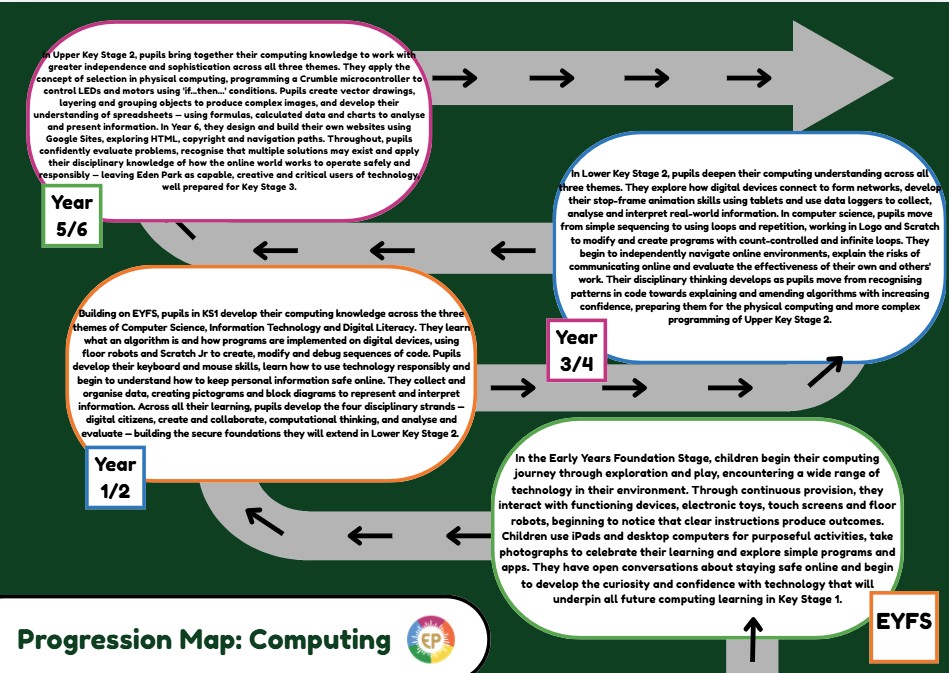
Computing Progression Roadmap
A clear overview of the journey our learners take from EYFS through to Year 6, showing how knowledge, computational thinking, digital skills and understanding develop and build progressively over time.
Supporting Documents and Resources
Additional information and resources to provide further insight into our Computing curriculum, alongside ideas, guidance and activities that families can use to support safe, creative and purposeful technology use at home.
At Eden Park, we want every child to have the opportunity to explore, create, problem-solve and innovate with technology. Through our Computing curriculum, children develop not only as confident users of technology, but as creative, resilient, critical and responsible digital citizens who understand that technology is a powerful tool for learning, communication and creativity.
Guiding Principle of Aspiration for Computing
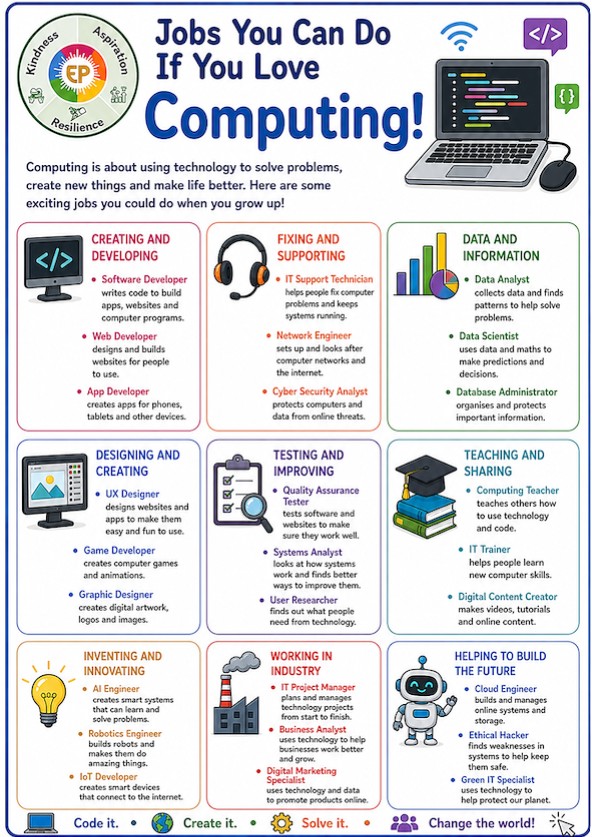
One of our Guiding Principles is Aspiration. We encourage our children to aspire every day, in everything they do, and to believe that their learning can open doors to a world of possibilities.
Whenever we begin a new Learning Enquiry in Key Stage 2, we share with the children examples of the careers and opportunities that their learning could lead to in the future. Whether they are exploring science, history, geography, art, computing or another area of the curriculum, we want them to see the real-world relevance of what they are learning.
By making these connections, we aim to open children's eyes to the wealth of possibilities available to them and help them understand that their learning today can shape their opportunities tomorrow.
We want every child to develop a “What could I become?” mindset — to dream big, recognise their own potential and understand that there are many different pathways to success. Most importantly, we want our children to leave us believing that their aspirations are within reach and that the knowledge, skills and attitudes they develop at school can help them to achieve them.
Please see 'Enriching the Curriculum Yr-Y6' for ways in which we extend learning and enrich children's computing experience.


